

This is The Aqueduct. Culture Currents
Note from the Editor

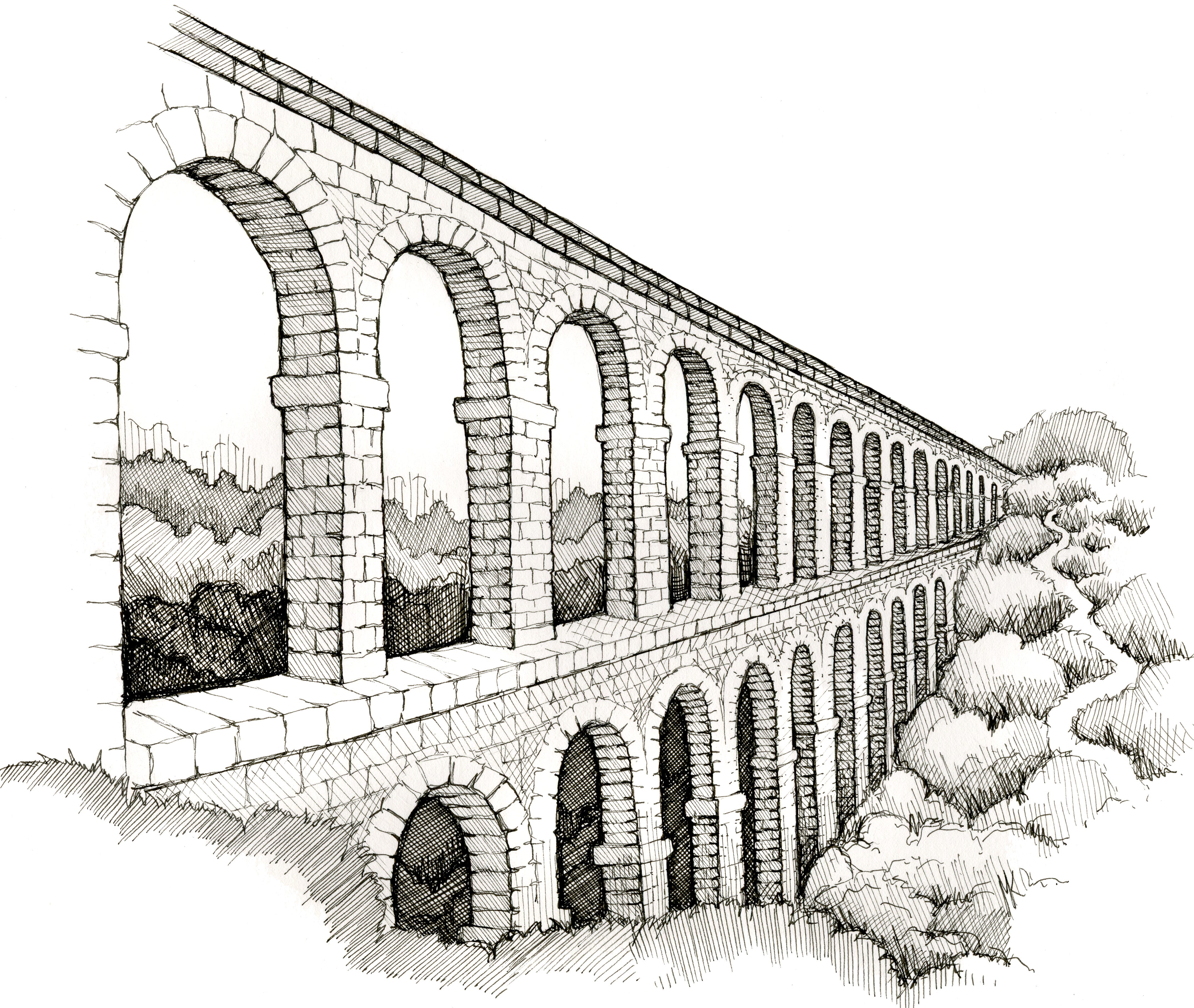
Open the (flood)gates…
aq·ue·duct | ˈäkwəˌdək(t), ˈakwəˌdək(t) |
noun an artificial channel for conveying water, typically in the form of a bridge across a valley or other gap.
• Anatomy a small canal containing fluid.
ORIGIN
mid 16th century: from obsolete French (now aqueduc), from Latin aquae ductus ‘conduit’, from aqua ‘water’ + ducere ‘to lead’.
(Source: New Oxford American Dictionary)
It’s been a long time coming…
Welcome to my Substack! The idea of running some sort of outlet to write about culture has been on my mind for way too long. Maybe as early as 2010, when I moved to the United States from Germany for Grad School. There was never a shortage of new ideas, but somehow I kept finding a way to stop myself from following through. Expectations be damned! This is about to change:
The Aqueduct - Culture Currents (TheAqueduct.cc) is an online publication and newsletter that engages in cultural commentary and social observations. Not overly political nor too tech focused, The Aqueduct aims to become a contextual archive of engaging curations of films, books, video games, and other cultural artifacts worthy of our time and attention.
Selected lists of genre films and directors may live side by side with short reviews of literary classics; or original essays on video games and zen buddhism. Brief entertainment recommendations will be featured as well as deep dives on cultural phenomena, unbound from the pressure of creating the next “viral moment.” Like that mountain source providing fresh water for our filthy cities, TheAqueduct.cc intends for steady quality, putting forward a variety of ideas and topics.
Expanding on the water metaphor, The Aqueduct contains three distinct article categories: Currents, Streams, and Sources.
Currents are observations that stay on the pulse without chasing trends. Feature-length articles, (guest) essays, columns, or in-depth background analyses with multiple perspectives.
Streams are the home for entertainment, recommendations, reviews and features on topics in film & tv, literature and video games.
Sources are original work in fiction, non-fiction and reportage by established and unknown authors alike and may be fluffy at times.
Why bother now and who am I?
After graduating with a PhD in 2018 and joining the freelance hustle in my favored town of choice—Brooklyn, New York—I have been in a constant uphill battle juggling between my personal creative ambitions, learning new professional crafts in the “creative industry” and making a living in maybe the most expensive (and therefore, unforgiving) city on the planet. While people around me have been starting families for a while now, overwhelm and confusion became more familiar companions to me throughout the years. I’m well aware of my stereotypical qualities, a humanities PhD turned media professional and writer in Brooklyn; but as immigrants from Germany and Mexico—my wife is originally from Mexico City—we very much identify with the type of New Yorkers that E.B. White called ‘passionate’— in his own words:
“There are roughly three New Yorks. There is, first, the New York of the man or woman who was born here, who takes the city for granted and accepts its size and its turbulence as natural and inevitable. Second, there is the New York of the commuter—the city that is devoured by locusts each day and spat out each night. Third, there is the New York of the person who was born somewhere else and came to New York in quest of something. Of these three trembling cities the greatest is the last—the city of final destination, the city that is a goal. It is the this third city that accounts for New York’s high-strung disposition, its poetical deportment, its dedication to the arts, and its incomparable achievements. Commuters give the city its tidal restlessness; natives give it solidity and continuity; but the settlers give it passion. ” —E.B. White, Here is New York.
I learned to love writing as a mode of thinking. To use it to improve my understanding of language and refine thoughts further. As a native German, my conception of language has been rather rigid, and while my prolonged academic education surely taught me about knowledge and critical thinking, it did not necessarily help to make my writing more playful. Instead, it amplified rationality and learning how to think structurally in pre-configured ideas of the past. In Germany even more so than in the US, which became especially obvious in the differing academic writing styles: Formulaic & strict vs. flowy & essaysistic. Meanwhile, I daydreamed of a more open outlet for my own thoughts and ideas. One with more freedom and less rules. Something that can be entertaining but also educating. Not bound by academic or commercial interest, only by my own curiosity. But taking blogging seriously? Come on, I was doing a PhD! This is about to change.
Paranoia and Surveillance: The Origins of harry_caul
Harry Caul is not my real name, but it was born as an online alias and is inspired by Gene Hackman’s character in Francis Ford Coppola’s The Conversation from 1973. Back in a film history class in Germany, we were discussing a bunch of paranoia thrillers from the 70s, and this was the movie I had to present on. In the film, Harry Caul is a surveillance expert from San Francisco that gets caught in a web of government and corporate conspiracy. It was not only for its paranoid and conspiratorial nature that the film became a classic in my personal memory but also for its main characters’ name and its ambiguous meaning. Little did I know, that other than being a fairly common name, (to) ‘Harry’ can also signify to ‘attack’ or ‘harass’ someone (Hackman’s character spies on the title giving Conversation with his sophisticated audio surveillance tools). ‘Caul’ on the other hand, is where the ambiguity gets even weirder. The birth ‘caul’ is a rare amniotic membrane some babies are born with and is said to bring good luck. So besides adding a superstitious layer, ‘Caul’ makes the veil in sur-veil-lance quite literal and therefore, visible.

To consider being born into a state of surveillance as a stroke of luck felt relatable for my own coming of age in the United States. By learning more about the paranoid 70s, their historical context (JFK, Nixon, Watergate) and experiencing the massive acceleration transformation that big tech introduced in the 2010s, I could not help but see similarities to those earlier times. Conspiracies, paranoia, propaganda, divisive tactics and politics, unpopular wars and the gutting of social services—history seems to repeat itself, with differences of course. Observing the evolution of big tech over the years was reason enough to plant a powerful seed of doubt for their motivations and ambitions, always expecting the moment their limitless hunger for power could sell out to the next highest bidder or a government looking for authoritarian control.
In this environment, Harry Caul has felt appropriate as an alias, providing my own little paranoid veil against the (perceived) threat of increasing surveillance. Growing up at a time when it was normal to use aliases online, for gaming, in forums or online chats (remember IRC, ICQ, AIM?)—harry_caul became my alter ego since I signed up for instagram in 2011, not wanting to use my real name to leave any unwanted traces online. In the age of so called ‘kidfluencers’ today, it almost sounds absurd that this used to be the default.
Does knowledge spark paranoia, while ignorance breeds innovation? I don’t want to give a definitive answer, but this question will surely resurface here from time to time.
Besides all that, The Conversation is still as relevant as when it came out 50+ years ago. You should really see it if you haven’t!
Support TheAqueduct.cc on Substack
To keep things flowing, The Aqueduct will aim to post new articles at least bi-weekly, preferably weekly. As this is a 100% independent passion project and human generated, please bear with me in case I should miss one at some point.
A free subscription will deliver the newsletter to your inbox, no strings attached. Some articles may be too long to be displayed in their entirety via email, so the archive will be available to browse in its entirety by navigating to the website (www.theaqueduct.cc). If you have any feedback, would like to collaborate or contribute with an article, feel free to comment or reach me on this platform (Harry Caul) or directly via email.
I don’t expect to make a living with this, but if you like what you read and are able to contribute with a paid subscription to support, any amount is appreciated ($5 is the minimum Substack allows for monthly, annual is discounted at $2.50/month, or sliding scale to “be like water my friend”).
Thanks for reading!
DisclAImer: Critical reading, thinking and writing are as valuable as they have ever been. Consultation of AI/LLMs for research and illustration purposes only.
Rooting for you. Brilliant start.